MITRE ATT&CK Evaluations What They Really Show About Security
MITRE ATT&CK Evaluations What They Really Show About Security When most executives hear “MITRE...


One cannot deny that cybersecurity has seen tremendous advancement in the past decade.
Despite this progress, breaches continue to occur with uncomfortable consistency. Post-incident investigations frequently show that warning signs appeared well before damage occurred. Assets remained exposed. Probing activity showed up in logs. Misconfigurations were known. The organization had visibility, but it did not stop the attack in time.
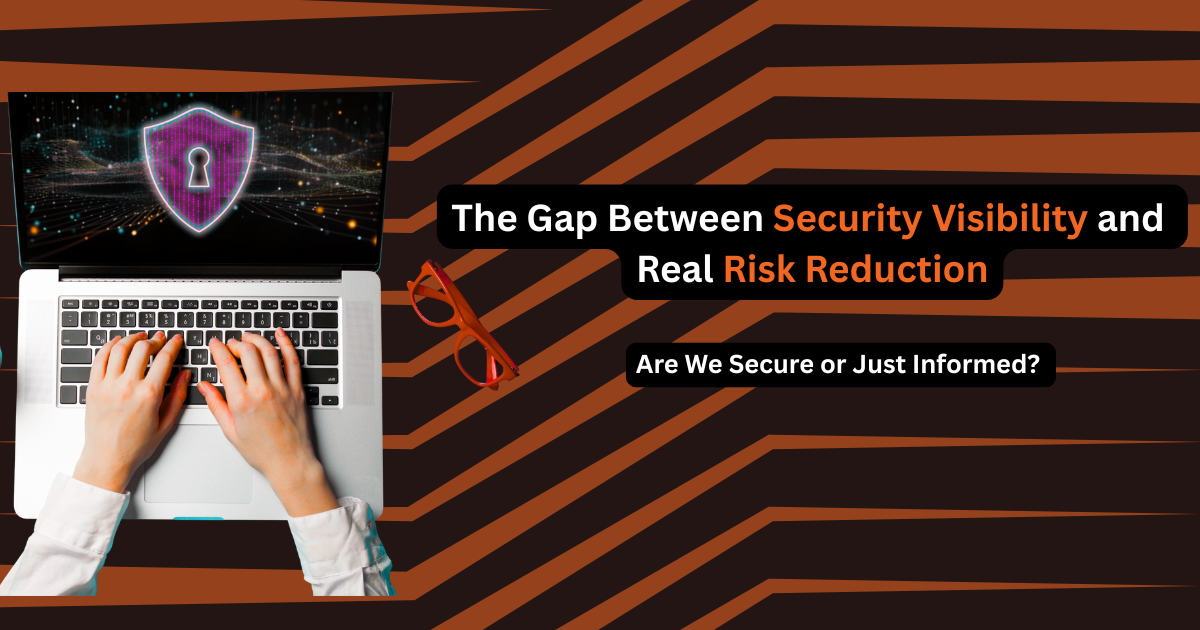
This reality highlights a difficult truth. Visibility does not equal security.
Many security programs measure success by how much they can observe. They add dashboards, expand telemetry, and invest in tools that promise deeper insight. Leadership receives richer reports and broader coverage metrics, which often create a sense of control.
But, organizations must ask whether their security strategy actively stops threats or merely documents them before an incident occurs.
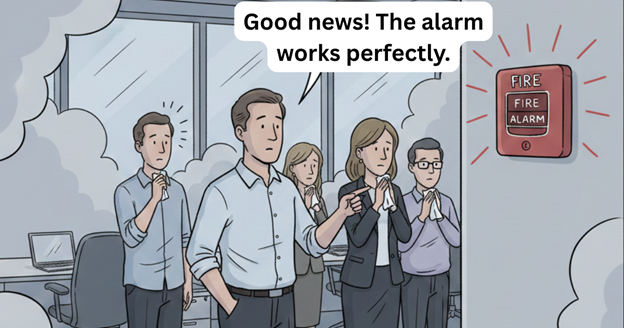
Visibility gives organizations confidence. Dashboards light up, alerts fire, and teams feel reassured that they know what is happening across the environment.
This assurance is crucial because you cannot defend what you cannot see.
But, many organizations get stuck in what can be called the visibility-to-action gap. This is the space between recognizing risk and actually reducing it.
An exposed service appears in a report, a risky identity gets flagged, or a misconfiguration surfaces, yet no immediate change follows. The gap exists because visibility does not assign ownership, enforce prioritization, or trigger remediation.
Attackers thrive in this gap. They do not care that an organization is aware of an issue. They exploit the delay between observation and action, knowing that most breaches occur not because risks are unknown, but because they are unaddressed.
Organizations often try to keep up with evolving threats by adopting new security solutions and consolidating existing tools. Detection, response, posture management, exposure management, identity analytics, and threat intelligence are layered over time, creating a network of capabilities that promise comprehensive coverage. However, adding more tools does not automatically improve protection.
Even when organizations invest in advanced solutions, they can become complex collections of disconnected systems if convergence is not built from the start. Alerts are generated, dashboards display threats, and signals are captured, but without coordinated processes, teams can struggle to turn visibility into timely action.
A major challenge arises when trying to connect existing tools with newly adopted solutions. Organizations attempt to integrate these systems into a single ecosystem, hoping to gain faster insights, real-time visibility, and coordinated responses. In practice, this integration is often complicated by differences in data formats, alert priorities, and workflow processes. Teams may spend significant time reconciling signals from old and new tools instead of responding to threats immediately.
Modern cyberattacks move fast.
Hackers can infiltrate environments, compromise accounts, and escalate privileges within minutes.
This means we should be able to detect threats or anomalies in seconds.
Preparedness begins long before malware executes or credentials are stolen. It starts when someone scans the perimeter, probes an exposed asset, or attempts to enumerate identities. A truly prepared organization does not simply observe these events. It interrupts them immediately.
Human-driven response alone cannot keep pace with modern threats. Hence there are 3 factors that should go hand in hand.
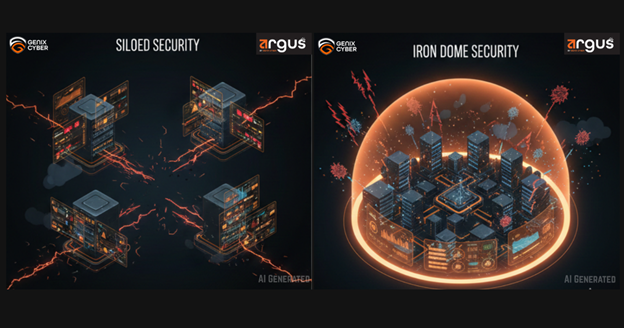
Cybersecurity should not be a collection of tools that simply observe attackers moving freely. It should function like an Iron Dome.
An Iron Dome detects threats early, evaluates intent and trajectory, and intercepts them before they can cause damage. It operates continuously, automatically, and in tight coordination. Effective cybersecurity follows the same principle. It allows nothing inside without validation. It stops threats while they are in motion and denies attackers the ability to linger, test, or return.
This perspective influenced how Genix Cyber approached the design of Argus. Rather than focusing on adding another dashboard or assembling a broad set of capabilities, the emphasis was on enabling a coordinated operating model that supports earlier intervention and faster containment. Argus brings together early threat detection, automated response, and continuous exposure management so these functions work in concert rather than in isolation.
Visibility and attack surface awareness provide an essential starting point, but they achieve greater impact when paired with strong threat detection, investigation, and response capabilities. Together, these elements support timely action, consistent ownership, and faster recovery when incidents occur.
Visibility provides important insights, but it does not prevent attacks on its own. Organizations reduce risk when detection, automated response, risk-based prioritization, and AI-driven analytics work together as a coordinated system. This approach functions like an Iron Dome, intercepting threats before they escalate and closing gaps that attackers could exploit.
To turn visibility into real protection, organizations should consider three key questions:
Answering these questions helps security teams act faster, reduce exposure, and prevent attackers from exploiting persistent weaknesses.
MITRE ATT&CK Evaluations What They Really Show About Security When most executives hear “MITRE...
The Low Hanging Fruits for Hackers in 2026 When the fruit hangs low, no...
Argus v2025.12 – Expanded Multitenancy, IoT Support, and Operational Enhancements We are pleased to...